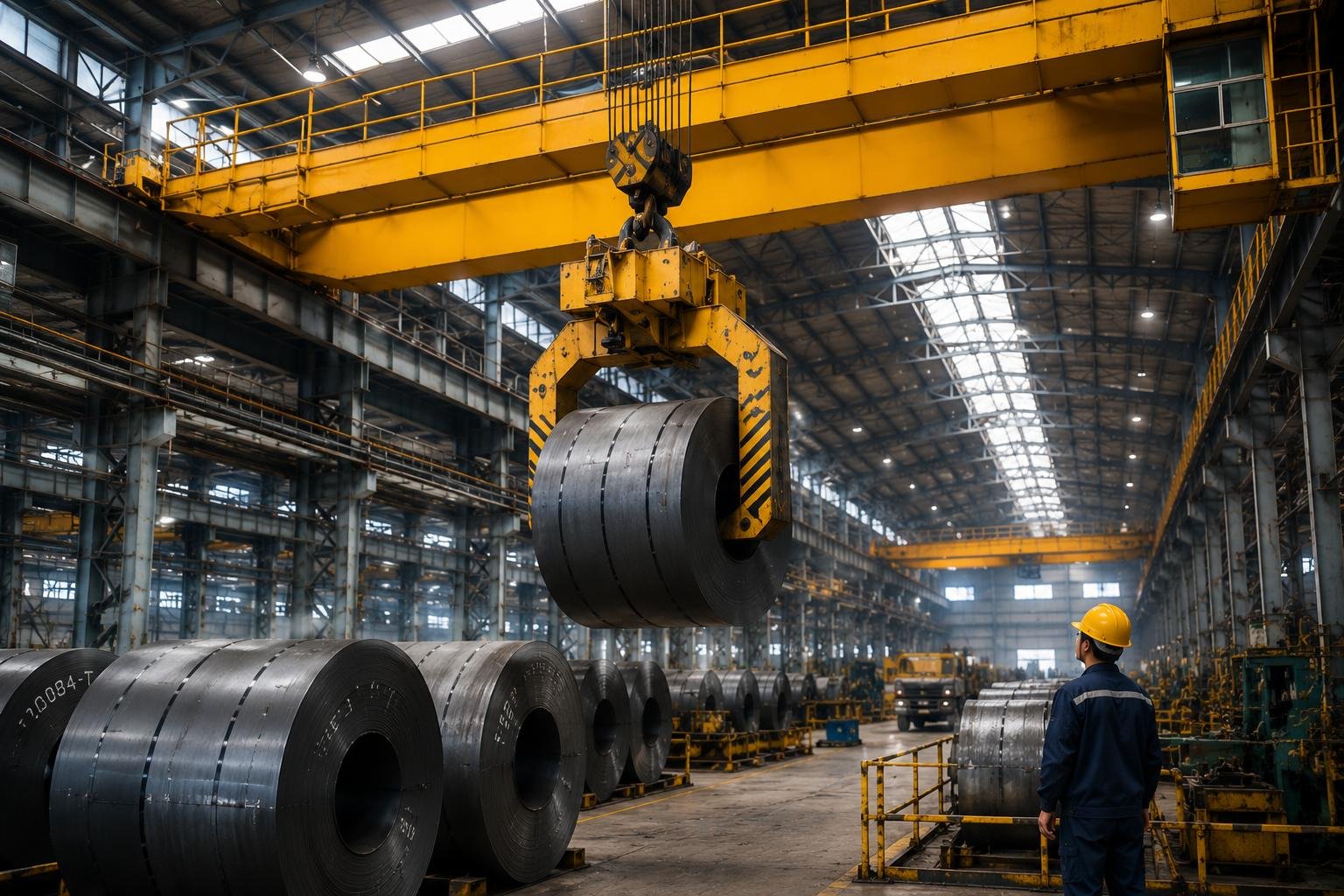
🏗️ CRANE AND LIFTING SAFETY
A suspended load can become a serious hazard in seconds. Safe lifting starts before the crane moves.
1. Why Is Crane Safety Important?
EOT (Electric Overhead Travelling) cranes are used in steel plants to move heavy materials and equipment. In steelmaking operations, some cranes also handle hot metal, liquid steel, red-hot ingots and slabs.
- A crane or lifting-component failure can cause serious injury, death and equipment damage.
- A swinging or falling load can strike people, structures or machinery.
- Unsafe lifting can damage production equipment and interrupt operations.
Key rule: Never stand or walk beneath a suspended load.
2. Common Crane and Lifting Hazards
| Hazard | What can happen? | Safe action |
|---|---|---|
| Overloading | Equipment failure or a dropped load | Check the load weight and crane's rated capacity. |
| Damaged lifting gear | Slings, hooks or accessories may fail | Inspect before use; report defects and remove defective gear from service. |
| People beneath the load | Crushing or fatal injury if the load falls | Keep clear of the load path and restricted lifting zone. |
| Load swinging | Collision with people, equipment or structures | Use controlled movements and avoid sudden starts or stops. |
| Poor communication | Unexpected crane or load movement | Use agreed signals and an authorised signal person where required. |
| Electrical or mechanical defects | Loss of control or unsafe crane movement | Stop operation and report the defect immediately. |
3. Safe Working Load (SWL)
SWL means Safe Working Load. It indicates the load that lifting equipment is permitted to handle under its specified conditions.
- Know the crane's rated capacity before lifting.
- Never exceed the marked capacity of the crane or any lifting accessory.
- Consider the capacity and configuration of the complete lifting arrangement.
- Do not estimate an unknown load by guesswork. Get its weight verified before lifting.
The IPSS standard specifies that the crane's safe working load and other identification data should be prominently displayed.
4. Before Starting a Lift
- Check the area: Keep people clear and confirm that the travel path is unobstructed.
- Inspect lifting gear: Check hooks, slings and other accessories for visible damage or defects.
- Check the load: Confirm the weight, lifting points, balance and stability.
- Confirm communication: Agree on signals and identify the person directing the lift.
- Check the crane: Report abnormal noise, defective controls, warning-device failure or other unsafe conditions.
- Plan the movement: Ensure the load can be moved without striking people, machinery or structures.
Follow the approved lifting plan, permit requirements and local operating procedure where applicable. Only authorised and trained personnel may operate the crane.
5. During Lifting and Movement
- Keep everyone clear of the suspended load and its travel path.
- Lift smoothly; avoid sudden movements and uncontrolled swinging.
- Never use a crane to carry people unless the equipment and operation are specifically designed and approved for that purpose.
- Never leave a suspended load unattended.
- Do not distract the crane operator or give conflicting signals.
- Stop if visibility, communication or load stability is lost.
- Never attempt to guide a moving load by placing your hands or body between the load and a fixed object.
6. Warning Devices and Crane Safety Features
The uploaded IPSS standard identifies several important crane safety arrangements:
- Audible warning device: Alerts people to crane movement.
- Emergency stop: Provides a means to stop crane operation in an emergency.
- Anti-collision/proximity sensing: Warns of approaching hazards or another crane.
- Safe working load marking: Makes crane capacity and identification data visible.
- Electrical isolation and warning indications: Help protect personnel during maintenance.
- Safe access and lighting: Support inspection, maintenance and visibility.
These are equipment-level safety provisions. Operators and maintenance personnel must follow the actual crane's approved operating and isolation procedures; never bypass a safety device.
7. If Something Goes Wrong
- Stop the movement if an unsafe condition develops and it is safe to do so.
- Warn nearby personnel and keep them away from the load and danger zone.
- Report immediately to the supervisor or control room through the plant's approved communication channel.
- Do not resume operation until the defect or hazard has been assessed and the equipment is authorised for use.
- In an emergency, follow the plant emergency procedure. Do not attempt an unauthorised rescue beneath or around a suspended load.
8. 🧠 Learning Bites
- Learning Bite 1: No person should stand or walk beneath a suspended load.
- Learning Bite 2: Never exceed the crane's or lifting accessory's rated capacity.
- Learning Bite 3: Inspect lifting gear before use; defective gear must not be used.
- Learning Bite 4: One agreed signal system helps prevent misunderstandings during lifting.
- Learning Bite 5: A warning alarm or anti-collision device is a safety aid, not permission to enter a danger zone.
- Learning Bite 6: If the load swings, communication fails or an abnormal condition occurs, stop and reassess.
Remember
Inspect → Confirm capacity → Clear the area → Communicate → Lift under control.
This lesson is for safety awareness. Follow current BSL/CRM-III procedures, crane-specific instructions and authorised practical training.
Source
SAIL/IPSS 2-02-007-18, Guidelines for Safety in EOT Cranes, First Revision, March 2018. This lesson summarises selected safety points from the supplied standard; it does not replace the complete standard or site-specific procedures.