LOTO (Lockout/Tagout): Safe Isolation of Hazardous Energy in CRM-III
Stop. Isolate. Lock. Tag. Verify. Then work.
Imagine a maintenance employee working near a roller table in the PLTCM section of CRM-III. The equipment appears to be stopped. Suddenly, a drive starts, a hydraulic cylinder moves, or a suspended component shifts because hazardous energy was not properly isolated. A single unexpected movement can cause crushing injuries, entanglement, burns or fatal accidents.
This is why Lockout/Tagout (LOTO) is a critical safety practice. It helps prevent the unexpected start-up of equipment and the release of hazardous energy while maintenance, inspection, cleaning or repair work is being performed.
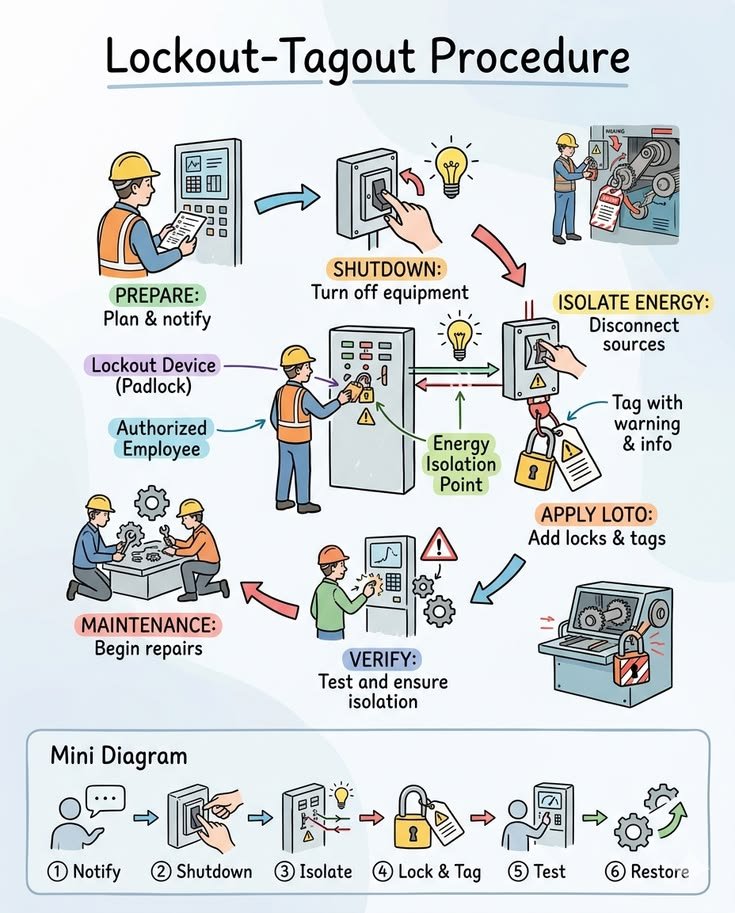
1. What is LOTO?
Lockout means securing an energy-isolating device with an appropriate lock so that the equipment cannot be re-energised unintentionally.
Tagout means attaching a clearly identifiable warning tag that communicates that the equipment is isolated or must not be operated, according to the approved site procedure.
LOTO is not simply switching off a machine or placing a warning board near a control panel. It involves identifying all relevant energy sources, isolating them using approved devices, applying the required locks and tags, safely controlling stored energy, and verifying that the equipment is in a safe condition before work begins.
A tag provides a warning; it does not physically prevent operation in the way an appropriate lock does. Tags must never be treated as a substitute for required locking where locking is possible and required by the applicable procedure.
2. Why is LOTO important in CRM-III?
CRM-III has production lines, furnaces, rotating machinery, cranes, pumps, gas systems and supporting utilities. Equipment may have several energy sources, and stopping one source does not necessarily eliminate every hazard.
- PLTCM: Unexpected movement of roller tables, rolls, strip-handling equipment, drives and hydraulic or pneumatic actuators.
- BAF: Electrical drives, hot equipment, furnace-related systems and residual thermal energy.
- HDGL: Moving strip, rotating rolls, drive systems, hot surfaces and associated auxiliary equipment.
- SPM: Roll movement, drive energy, mechanical forces and stored energy in associated systems.
- CPL and TLIL: Slitting or cutting mechanisms where fitted, rotating equipment, coil-handling systems and automatic sequences.
- H₂ Plant and gas utilities: Gas pressure, potentially hazardous atmospheres and associated electrical or mechanical equipment. Energy isolation must be coordinated with the approved gas-system safety procedure.
- Overhead cranes: Electrical motion, suspended loads and stored mechanical energy. A load must be safely landed or otherwise secured before people are exposed to its danger.
- Water supply, TTP and ETP: Pumps, motors, pressurised pipelines, agitators and other equipment that may restart automatically.
- Roll bearing shop: Rotating machinery, presses, lifting equipment and components that can move or fall unexpectedly.
These are examples of potential hazards. The actual isolation points and required controls must be determined from the specific equipment, its approved isolation instructions and the applicable Bokaro Steel Plant procedures.
3. Understand the different forms of hazardous energy
Electrical energy
Motors, drives, control circuits and electrical panels may expose workers to electric shock, arc-flash or unexpected movement. A stop command or an HMI indication does not establish safe electrical isolation. The required electrical isolation and verification must be completed by authorised personnel.
Hydraulic energy
Hydraulic systems can retain pressure even after a pump stops. A cylinder or actuator may move suddenly if pressure is released or a valve changes state. The system must be isolated and residual pressure safely controlled under the approved procedure.
Pneumatic energy
Compressed air can move cylinders, actuators or mechanical components unexpectedly. Isolating the air supply alone may not remove trapped pressure. Follow the specified depressurisation and verification process.
Mechanical and gravitational energy
Rotating components, tensioned parts, springs, raised machine elements and suspended loads may move even when the main power is off. Components must be safely restrained, supported, landed or otherwise secured as required.
Thermal energy
Furnaces, heated rolls, hot pipelines and other equipment may remain dangerously hot after shutdown. Allow for cooling and verify safe conditions according to the relevant procedure before work or contact.
Pressure and hazardous process materials
Gas, steam, water, chemicals or other process materials may remain in connected equipment and pipelines. Depending on the task, additional isolation, draining, purging, gas testing or other controls may be necessary. These activities must be performed by competent authorised personnel under the relevant procedure.
4. The LOTO process: a safe sequence
Step 1 — Plan the job and identify every energy source
Identify the exact equipment and work scope. Consult the approved drawings, equipment-specific isolation instructions and risk assessment. Consider normal supplies, alternative feeds, automatic start commands, connected equipment and stored energy. Involve the authorised operating and maintenance personnel.
Step 2 — Inform affected personnel
Communicate the planned shutdown and isolation to the concerned operating team, maintenance personnel, contractors and other affected work groups. Confirm how the equipment will be taken out of service and how the work area will be controlled.
Step 3 — Shut down the equipment correctly
Use the approved shutdown sequence. A normal stop is only the first step; it does not by itself establish isolation. Make sure the shutdown is coordinated with the responsible operating personnel.
Step 4 — Isolate all identified energy sources
Authorised personnel must operate the designated energy-isolating devices in accordance with the approved isolation plan. Depending on the equipment, this may involve electrical disconnects, isolating valves or other approved devices. Control every relevant source, including alternative supplies and energy that can enter from connected equipment.
Step 5 — Apply locks and tags
Apply the required personal or other approved locks and clearly identifiable tags to the designated isolation points. Follow the plant's group-isolation arrangements, where applicable. Tags should make the isolation status and responsible person identifiable as required by the site procedure.
Never rely on an emergency-stop button, selector switch, software command, HMI screen or interlock alone as an energy-isolating device.
Step 6 — Release or restrain stored energy
Safely discharge, drain, depressurise, cool, block or restrain hazardous energy as required by the approved procedure. Confirm that components cannot fall, rotate, shift or move unexpectedly. Some energy sources can reaccumulate, so the required controls may need to remain in place throughout the job.
Step 7 — Verify isolation and the safe condition
Before starting work, authorised personnel must verify that the isolation is effective and that hazardous energy has been controlled. Use the equipment-appropriate method specified in the site procedure. Electrical testing must be performed by qualified authorised personnel using the required test method. Where a try-start or functional check is specified, it must be performed under controlled conditions, with personnel clear of danger, and controls returned to the required safe state afterward.
Critical principle: Never assume that equipment is safe merely because a lock is fitted or an indicator shows “OFF”. Verify the actual safe condition using the approved method.
Step 8 — Perform the authorised work
Begin only after the required isolation and verification are complete and the applicable permit has been authorised. Keep locks, tags, barriers and other safeguards in place. Do not bypass an isolation, operate equipment, or expand the work scope without the required authorisation and reassessment.
Step 9 — Restore equipment through a controlled handover
After the work is complete, inspect the work area, remove tools and temporary materials, reinstall guards where required, and account for all personnel. Each lock must be removed according to the approved procedure by the person authorised to remove it. Any exceptional lock-removal process must follow the plant's formal procedure.
Inform the responsible operating personnel, confirm that the work area is clear, and complete the required handover. Only authorised personnel may restore energy and return the equipment to service through the approved restoration sequence.
5. Practical CRM-III example: maintenance on a PLTCM roller table
Suppose a team must repair a component near a PLTCM roller table. The area may involve an electric drive, hydraulic or pneumatic actuators, connected equipment and the possibility of automatic movement.
- The work team defines the exact equipment and task with the authorised operating personnel.
- All relevant energy sources and possible movement hazards are identified.
- The equipment is shut down and the required energy-isolating devices are operated by authorised personnel.
- The prescribed locks and tags are applied under the approved isolation arrangement.
- Stored pressure is safely controlled, and components that could move or fall are secured.
- Isolation effectiveness and the safe condition are verified using the specified method.
- The required work permit and other controls are confirmed before the maintenance team begins work.
- After the repair, the team checks the equipment, clears the area and completes the formal handover before authorised restoration.
If another team needs to work on the same equipment, its personnel must be included in the approved group-isolation arrangement. One worker's lock must not be treated as protection for everyone unless the site's formal procedure explicitly establishes the required protection for each person.
6. Personal locks and group LOTO
Where the approved procedure requires personal locks, each exposed worker must be protected through the prescribed personal-lock or equivalent approved arrangement. In group work, a lock box or other formal group-isolation system may be used when specified by the plant procedure.
- Never share keys or casually transfer personal locks between workers.
- Never remove another person's lock simply because the work appears complete or the person is not nearby.
- Follow the formal exceptional lock-removal process if the lock owner is unavailable.
- For shift changes, ensure that protection remains continuous and that incoming and outgoing personnel follow the approved transfer procedure.
- Before work resumes after a handover, confirm that each affected worker remains protected under the required isolation arrangement.
7. Special attention: cranes, gas systems and utilities
Crane maintenance
Crane isolation must address the relevant electrical and mechanical hazards. A suspended load must never be left in a condition where it can fall onto personnel. Land or safely secure loads, prevent hazardous movement and follow the crane-specific isolation and maintenance procedure.
H₂ Plant and gas utilities
LOTO alone may not make gas-system work safe. The work may also require approved process isolation, control of residual gas, purging, gas testing, ventilation and other safeguards appropriate to the system. Hydrogen is highly flammable, so ignition control and emergency arrangements are essential. Do not loosen gas connections or begin line-breaking work without the required authorisation and verified controls.
Pumps and pipelines in water supply, TTP and ETP
Isolating a pump motor does not necessarily eliminate pressure in the pipeline or prevent backflow from another source. Consider connected systems, pressure, automatic restart and any other energy source that could affect the work.
8. Common LOTO mistakes
- Switching off a machine without isolating its energy sources.
- Ignoring secondary supplies, stored pressure or connected equipment.
- Assuming that a warning tag alone prevents operation.
- Beginning work without verifying the effectiveness of isolation.
- Relying only on an HMI display, selector switch or emergency-stop button.
- Leaving raised components, suspended loads or other stored energy unsecured.
- Removing another person's lock without following the formal procedure.
- Failing to maintain protection during shift change or group work.
- Restoring power before personnel are clear, guards are restored and handover requirements are met.
9. Responsibilities during LOTO
- Authorised isolation personnel: Identify and isolate energy sources, apply the required controls and perform verification within their authorisation.
- Operating personnel: Coordinate shutdown, identify the correct equipment, communicate operational restrictions and manage handover.
- Maintenance supervisor or work leader: Confirm the job scope, required permit, team readiness and compliance with the isolation arrangements.
- Employees and contractors: Understand the hazards, follow the approved isolation arrangements and never disturb another person's lock or tag.
- Responsible authority: Ensure that exceptional situations, changes to the job and restoration of equipment are handled under the approved procedure.
10. Final safety check before work
- The exact equipment and work scope have been confirmed.
- All relevant energy sources have been identified.
- Required isolations, locks and tags are in place.
- Stored energy has been released, restrained or otherwise safely controlled.
- Isolation effectiveness and the safe condition have been verified.
- Required work permits and task-specific controls are in place.
- All affected personnel understand the isolation and their responsibilities.
This is a learning checklist, not a replacement for the formal isolation certificate, permit, equipment-specific checklist or mandatory site procedure.
11. The most important lesson
In CRM-III, hazardous energy can remain present even after a machine has stopped. Electrical power, pressure, gravity, heat and stored mechanical forces can cause unexpected movement or release energy without warning.
Whether the work is on a PLTCM roller table, BAF auxiliary equipment, an HDGL drive, a CPL mechanism, a utility pump or a crane, follow the current approved Bokaro Steel Plant procedures and use only authorised isolation methods.
Remember: Identify every energy source. Isolate it. Lock and tag it. Control stored energy. Verify the safe condition. Work only when authorised.
This lesson is for safety awareness and training. It does not replace Bokaro Steel Plant's approved LOTO, electrical safety, process isolation, gas safety, crane maintenance or Permit to Work procedures.