🪜 Work at Height Safety — Fall Prevention and Protection
Safety message: Never work at height without assessing the risk, providing suitable fall protection and ensuring a safe way to rescue a fallen worker.
Working at height is any work where a person could fall and suffer injury. The Ministry of Steel's Safety Guideline SG/02 covers work at heights of more than 2 metres and addresses safe access, ladders, scaffolds, mobile elevated work platforms and roof work.
In CRM-III and other steel-plant areas, work at height may occur on machine platforms, mill structures, crane access areas, pipe racks, cable routes, roofs and during maintenance or shutdown jobs. A fall from even a lower level can cause serious injury, so all fall hazards must be assessed.
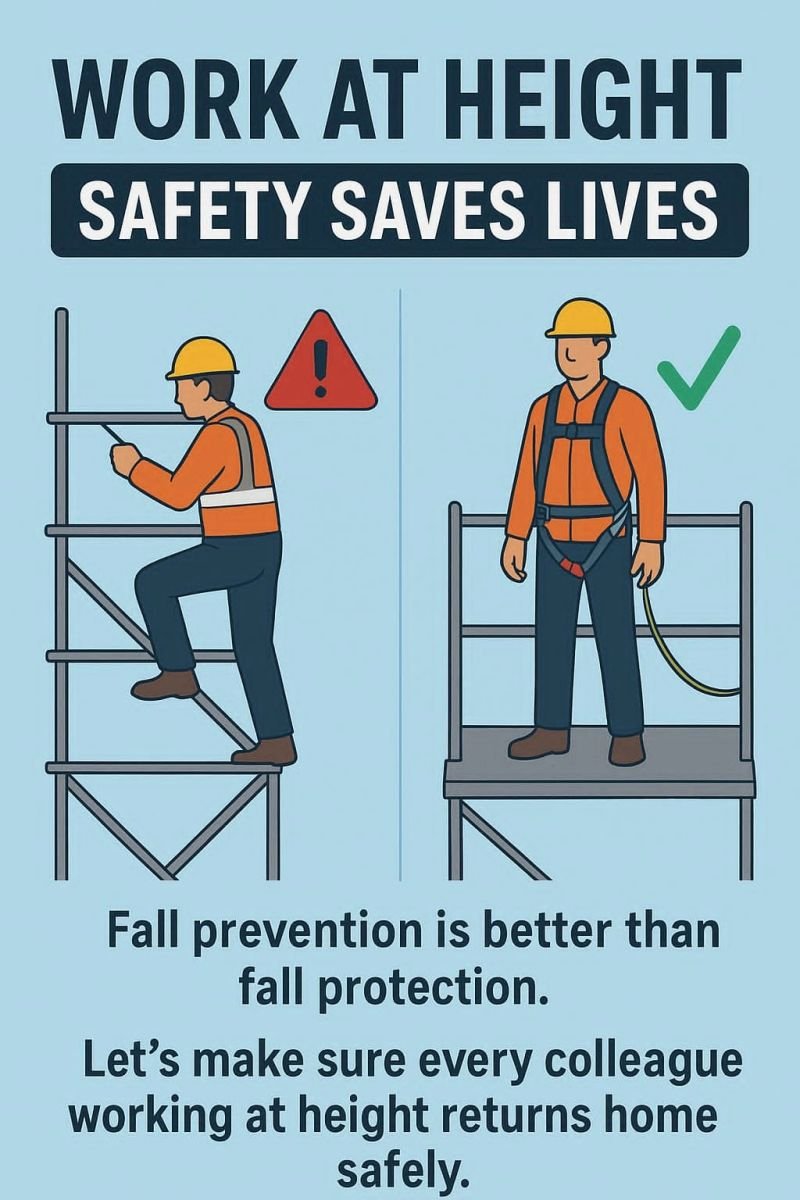
1. Common Work-at-Height Hazards
- Unprotected edges: Falling from platforms, walkways, roofs or elevated structures without adequate edge protection.
- Unsafe ladders: Using damaged, unstable or incorrectly positioned ladders.
- Defective scaffolds: Working on incomplete platforms, missing guardrails or unsecured boards.
- Openings and fragile surfaces: Falling through uncovered floor openings, roof openings or surfaces that cannot support a person's weight.
- Falling objects: Tools, bolts and materials dropping onto people below.
- Electrical hazards: Contact with overhead electrical lines or exposed electrical equipment.
- Adverse weather: Slippery surfaces, strong winds, lightning or poor visibility.
2. Before Starting the Job
- Assess the risk: Identify fall hazards, access requirements, nearby machinery, electrical hazards and objects that could fall.
- Obtain authorisation: Follow the plant's work-at-height permit or pass system and the applicable work-permit procedure.
- Prefer safer methods: Where practicable, carry out work from ground level or use a properly designed work platform rather than climbing unnecessarily.
- Inspect access equipment: Check ladders, scaffolds, platforms, guardrails, access gates and fall-protection equipment before use.
- Check the working area: Ensure adequate lighting, safe access, a stable working surface and suitable weather conditions.
- Conduct a safety briefing: Explain the work sequence, hazards, communication method and emergency rescue plan to everyone involved.
- Control the area below: Barricade the drop zone and display warning signs to protect people from falling objects.
3. Safe Use of Full-Body Harnesses
- Use an approved full-body harness and compatible fall-protection equipment suitable for the task.
- Inspect the harness, lanyard, connectors, hooks and lifeline before use. Do not use equipment that is damaged, defective or has been involved in a fall unless it has been assessed and cleared under the manufacturer's procedure.
- Connect only to a designated, suitable anchorage point approved for the fall-protection system. Never attach to an unverified pipe, handrail, cable tray or other unsuitable structure.
- Use the specified fall-arrest or restraint arrangement and maintain continuous protection wherever required by the approved procedure.
- Check clearance below the work area so a fall-arrest system will not allow the worker to strike a lower platform or obstruction.
- Ensure the harness fits correctly and all buckles and connectors are secured as instructed by the manufacturer.
- Never treat a harness as a substitute for guardrails or other collective protection where these can be provided.
4. Ladder Safety
- Use the correct type and length of ladder for the task. Inspect it for damaged rungs, feet, rails or locking devices.
- Place the ladder on firm, level ground and secure it against slipping or movement.
- Maintain three points of contact while climbing whenever practicable, and face the ladder.
- Keep your body between the ladder rails; do not overreach. Move the ladder instead.
- Do not climb while carrying tools or materials in a way that prevents a secure grip. Use a tool belt, hoist or other suitable method.
- Do not use metal ladders where electrical contact could create a hazard.
- Never use a ladder as a makeshift bridge or work platform unless it is specifically designed and approved for that purpose.
5. Scaffold and Platform Safety
- Use scaffolds that have been erected, inspected and released for use by competent authorised personnel.
- Check that platforms are complete, properly secured and free from slippery materials and unnecessary items.
- Ensure required guardrails, midrails, toe boards and safe access are provided.
- Never remove scaffold components, guardrails or braces without authorisation.
- Do not overload a platform or use boxes, drums or loose materials to gain extra height.
- Do not use an unsafe or incomplete scaffold. Report defects and keep people off it until it is made safe.
6. Prevent Falling Objects
- Secure tools and small components when working above ground level.
- Use tool lanyards where suitable and approved for the task.
- Do not throw tools, bolts or materials from an elevated position.
- Keep materials away from platform edges and openings.
- Barricade the area below and prevent unauthorised entry during overhead work.
- Wear a safety helmet as required, but remember that a helmet does not replace protection from falling objects.
7. CRM-III Examples
- Mill maintenance: Before working on elevated mill structures, obtain the required authorisation and ensure nearby machinery and hazardous energy are controlled where necessary.
- Crane access or maintenance: Use designated access routes and approved fall-protection arrangements. Coordinate with the responsible crane and operations personnel.
- Pipe racks and cable routes: Check for electrical hazards, fragile or slippery surfaces and the need for isolation.
- Roof or sheet replacement: Treat roof sheets as potentially fragile until their load-bearing capacity is confirmed. Use the approved roof-work method and fall-protection system.
8. When Must Work Stop?
- Required fall protection, guardrails or safe access are missing or defective.
- The permit, authorisation or required isolation is not in place.
- Strong winds, lightning, heavy rain or other unsafe weather conditions make the task hazardous.
- Lighting or visibility is inadequate.
- The worker's harness or other safety equipment is damaged.
- The drop zone cannot be adequately protected from falling objects.
Stop the work, inform the supervisor and restart only after the unsafe condition has been corrected and authorisation is confirmed.
9. Emergency and Rescue Preparedness
- Establish a suitable rescue plan before work begins. Do not rely solely on calling emergency services after an incident.
- Ensure trained rescuers, suitable rescue equipment and a communication method are available as required by the plan.
- If a worker falls and is suspended in a harness, raise the alarm immediately and activate the approved rescue procedure.
- Do not attempt an improvised rescue that puts additional people at risk.
- Arrange prompt medical assessment for a worker involved in a fall, even if serious injury is not immediately apparent.
- Quarantine fall-arrest equipment involved in a fall until it has been assessed under the manufacturer's and plant's procedures.
10. Practical Safety Scenario
Situation: During maintenance on an elevated platform, a worker discovers that the guardrail is missing from one side. The job is nearly complete, and the worker wants to finish quickly.
Correct response:
- Stop the work and do not approach the unprotected edge.
- Inform the supervisor and prevent unauthorised access to the affected area.
- Have the guardrail restored or implement an approved alternative fall-protection arrangement before work resumes.
- Restart only after the area is checked and authorised for safe work.
11. Quick Knowledge Check
- What is the height threshold specified in Ministry of Steel guideline SG/02?
- Why must a harness be connected to a suitable approved anchorage point?
- What should you do if a scaffold is incomplete or has a missing guardrail?
- Why must the area below overhead work be barricaded?
- What arrangements must be made before work at height begins?
Key Takeaway
Plan the job. Obtain authorisation. Inspect the equipment. Protect against falls. Secure tools. Prepare for rescue. Never continue work at height when required safety controls are missing.
References:
- Ministry of Steel, Government of India, Safety Guidelines for Iron & Steel Sector, Doc. No. SG/02, Rev. 00, effective 14 October 2019.
- Ministry of Steel, Government of India, Safety Code for Working at Height, Doc. No. SC/02.